New York City
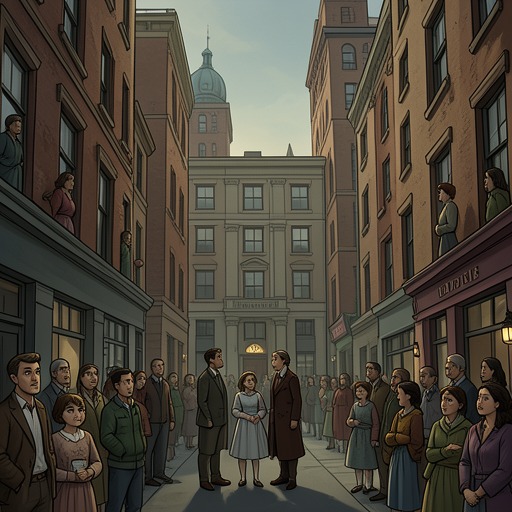
The People UpstairsNew York City is the principal Earth setting of the Greenes’ hidden life: a crowded, watchful city where ordinary routines—elevators, subways, shopping, schooling, and neighborhood sociability—become tests of alien concealment. Its importance lies in the contradiction it imposes on the family. New York City offers the anonymity necessary for a covert posting, yet its dense social world continually threatens to expose the Greenes’ bodies, origins, and family circumstances.
Urban Setting and Social Surveillance
New York City first appears through the self-service elevator of the Greenes’ apartment building, where May Greene encounters Mrs. Gottesmann. The exchange is outwardly courteous, but the building’s residents monitor one another closely and gather at the basement washing machines to circulate whatever private information they can obtain. May’s unusual accent has occupied the neighbors’ speculation for nearly ten years. Unlike Mrs. Gottesmann’s clearly German accent, May’s cannot be assigned to a recognizable national origin, making her foreignness perceptible without making its source identifiable.
The city’s public transportation intensifies the strain of ordinary life. May returns exhausted from visiting Dr. Robinson, blaming the shopping and the subways, while the conversation with Mrs. Gottesmann turns these mundane complaints into part of her social performance. In New York City, even an incidental remark about trains can help sustain the appearance of normality; silence, fatigue, or an accent that cannot be placed may instead invite renewed curiosity.
The apartment building functions as a compressed version of the city’s social environment. The Greenes’ apartment is furnished in the conventional department-store modern style associated with an earlier decade, but beneath this banality lies an emotional impression of alienness that a casual visitor would not consciously identify. The superintendent is the only person with frequent access to the apartment, and his continual anger inadvertently protects the Greenes by making him unreceptive to subtle impressions. The home is therefore both refuge and stage: private enough for the disguises to be removed, yet still vulnerable to the perceptions of neighbors and landlords.
The City as a Site of Disguise
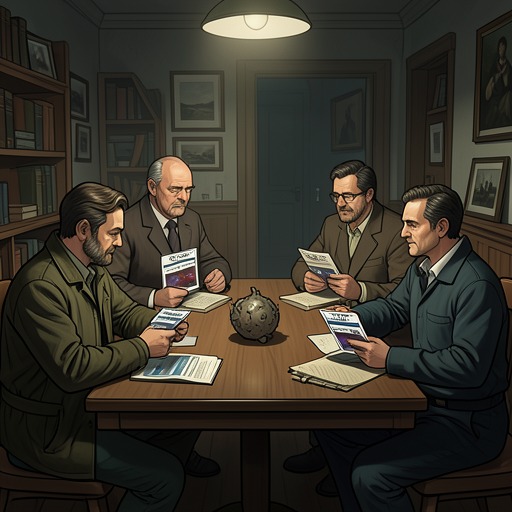
New York City requires the Greenes to convert their bodies into a carefully maintained public appearance. Inside their apartment, May removes the silk-thin plastomask from her face and takes out her contact lenses before telling Dan Greene that she is pregnant. The removal of these objects marks the boundary between the city’s human-facing surface and the concealed Milotan body beneath it. Earth-made possessions are preferred, and even a terrestrial hairbrush has been subtly altered for May’s needs; Milotan artifacts cannot safely be left lying around.
Their adaptations are permanent rather than merely cosmetic. The Greenes were assigned to Earth for life, and the physical changes that make them passable in New York City would leave them grotesque on Milotis. Their situation turns the city into a place of irreversible estrangement: they cannot simply return home, but neither can they fully belong to the society in which they live. New York City’s apparent modern normality thus rests on an invisible bodily cost.
The city also shapes the consequences of May Greene’s unexpected pregnancy. Dr. Robinson can provide medical assistance locally, but the pregnancy threatens the Greenes’ assignment and raises the prospect of disgrace before their Bureau. May and Dan consider returning to Milotis, even though they understand that they could not be readapted successfully. Their Earth residence therefore becomes inseparable from the question of whether a family can be formed within a cover identity designed to prevent reproduction.
Family Life and Economic Pressure
After Terence Greene is born, New York City changes from a posting shared by two covert agents into the setting of an improvised household. Because Terence is born in the United States of America, he possesses a genuine birth certificate and does not need forged papers, making him legally different from earlier Milotans on Earth. Yet his presence increases the practical demands of city life. Milotan babies require the same exhausting care as terrestrial infants, and in a technologically inferior environment the work falls to May because the robots that would have cared for him on Milotis are unavailable.
May Greene remains at home while Dan Greene continues working, and the loss of her income sharply reduces the family’s security. Salaries from terrestrial jobs were intended only to supplement allowances from the Milotan government, while living on an alien planet is unusually expensive. The family first abandons luxuries, including Dan’s specially imported tobacco substitute and May’s repackaged Milotan delicacies, and eventually cuts into necessities. New York City is consequently not just a background of surveillance; it is an expensive material system that makes the Greenes’ covert domestic arrangement increasingly difficult to sustain.
May must also take Terence outside every day in the Earth sun, which is preferable to no sun at all, while exchanging evasive pleasantries with neighbors gathered outside among perambulators and deck chairs. She once brought him to the roof at night to see the distant glimmer of Milotis, but stopped when the neighbors became curious. The city’s shared spaces make even an intimate act of cultural remembrance a possible security risk.
School, Exposure, and Belonging
New York City’s institutions eventually force Terence into a wider human society. At six, he must attend school despite his parents’ efforts to keep him away from other children. May chooses a private day school, hoping to secure the best limited educational advantages available on Earth while avoiding the greater exposure of boarding school. To prevent medical examination, she tells the principal that the Greenes are Christian Scientists, using a familiar human explanation to protect the child’s face and hands from scrutiny.
The school initially seems manageable because Terence is self-possessed and academically capable without being conspicuously brilliant. The arrangement fails when swimming lessons are introduced. Terence’s concealed body cannot withstand the ordinary educational expectation that children appear unclothed or nearly so before one another. The event transforms the school from a controlled extension of the family’s disguise into a site of direct bodily exposure.
Terence’s response makes the city’s pressure personal rather than merely procedural. He tells May that he is different as an accusation, turning the truth his parents had partially withheld back upon them: their secrecy has left him aware of his alienation without giving him a full account of its cause. The principal’s cold intervention shows how quickly a supposedly genteel institution can become an authority demanding explanation.
The episode ends with a rare movement toward family intimacy. After May manages the encounter with outward politeness, Terence clings tightly to her hand on the way to the car, and she feels closer to him than at any time since his infancy. During the drive, he asks in halting Milotan to hear about Milotis and confirms that such a place exists, where everyone is like them. New York City has exposed the child to human society, but that exposure also prompts him to seek a more truthful connection with his parents and his origin.
Narrative Significance
New York City embodies the double condition of the Greenes’ Earth existence. It is anonymous enough to conceal them among immigrants and foreign accents, yet intimate enough that neighbors, schools, doctors, and public routines continually press against the disguise. Its subways, apartment corridors, rooftops, and classrooms make alienation visible through ordinary spaces rather than through distant or fantastical landscapes.
The city also links colonial strategy to domestic labor. The Greenes’ covert mission depends on carefully managed appearances, but pregnancy, childcare, reduced income, and compulsory schooling turn that mission into a family problem. In New York City, Terence is at once a legally documented citizen of the United States of America and a child whose body cannot safely meet the city’s ordinary expectations. The setting therefore gives concrete form to the story’s central tension: adaptation may secure residence, but it cannot erase difference, and the very institutions that define normal life eventually compel the family to confront it.